
P.S. Free & New KCNA dumps are available on Google Drive shared by FreeDumps: https://drive.google.com/open?id=1k_1BmLRantKJOkWTJpOvx0j7xs2ZVcbw
It is of no exaggeration to say that sometimes a certification is exactly a stepping-stone to success, especially when you are hunting for a job. The KCNA study materials are of great help in this sense. People with initiative and drive all want to get a good job, and if someone already gets one, he or she will push for better position and higher salaries. With the KCNA test training, you can both have the confidence and gumption to ask for better treatment. To earn such a material, you can spend some time to study our KCNA study torrent. No study can be done successfully without a specific goal and a powerful drive, and here to earn a better living by getting promotion is a good one.
Linux Foundation KCNA (Kubernetes and Cloud Native Associate) Exam is a certification program designed for professionals who want to validate their knowledge and skills in the field of cloud computing and containerization. KCNA Exam is aimed at individuals who want to demonstrate their proficiency in Kubernetes, a popular container orchestration system, and other cloud-native technologies.
>> Reliable KCNA Braindumps <<
With the rapid development of the economy, the demands of society on us are getting higher and higher. If you can have KCNA certification, then you will be more competitive in society. We have chosen a large number of professionals to make KCNA learning question more professional, while allowing our study materials to keep up with the times. Of course, we do it all for you to get the information you want, and you can make faster progress. You can also get help from KCNA Exam Training professionals at any time when you encounter any problems. We can be sure that with the professional help of our KCNA test guide you will surely get a very good experience. Good materials and methods can help you to do more with less. Choose KCNA test guide to get you closer to success.
NEW QUESTION # 232
What is an ephemeral container?
Answer: C
Explanation:
B is correct: an ephemeral container is a temporary container you can add to an existing Pod for troubleshooting and debugging without restarting the Pod. This capability is especially useful when a running container image is minimal (distroless) and lacks debugging tools like sh, curl, or ps. Instead of rebuilding the workload image or disrupting the Pod, you attach an ephemeral container that includes the tools you need, then inspect processes, networking, filesystem mounts, and runtime behavior.
Ephemeral containers are not part of the original Pod spec the same way normal containers are. They are added via a dedicated subresource and are generally not restarted automatically like regular containers. They are meant for interactive investigation, not for ongoing workload functionality.
Why the other options are incorrect:
* D describes init containers, which run before app containers start and are used for setup tasks.
* C resembles the "sidecar" concept (a supporting container that runs alongside the main container), but sidecars are normal containers defined in the Pod spec, not ephemeral containers.
* A is not a definition; ephemeral containers are not "root by design" (they can run with various security contexts depending on policy), and they aren't limited to infosec use cases.
In Kubernetes operations, ephemeral containers complement kubectl exec and logs. If the target container is crash-looping or lacks a shell, exec may not help; adding an ephemeral container provides a safe and Kubernetes-native debugging path. So, the accurate definition is B.
=========
NEW QUESTION # 233
What is the difference between a Deployment and a ReplicaSet?
Answer: D
Explanation:
A Deployment is a higher-level controller that manages ReplicaSets and provides rollout/rollback behavior, so D is correct. A ReplicaSet's primary job is to ensure that a specified number of Pod replicas are running at any time, based on a label selector and Pod template. It's a fundamental "keep N Pods alive" controller.
Deployments build on that by managing the lifecycle of ReplicaSets over time. When you update a Deployment (for example, changing the container image tag or environment variables), Kubernetes creates a new ReplicaSet for the new Pod template and gradually shifts replicas from the old ReplicaSet to the new one according to the rollout strategy (RollingUpdate by default). Deployments also retain revision history, making it possible to roll back to a previous ReplicaSet if a rollout fails.
Why the other options are incorrect:
A is false: Deployments absolutely control the number of replicas via spec.replicas and can also be controlled by HPA.
B is false: ReplicaSets do guarantee that a stable number of replicas is running (that is their core purpose).
C is false: a Deployment is not "a ReplicaSet with annotations." It is a distinct API resource with additional controller logic for declarative updates, rollouts, and revision tracking.
Operationally, most teams create Deployments rather than ReplicaSets directly because Deployments are safer and more feature-complete for application delivery. ReplicaSets still appear in real clusters because Deployments create them automatically; you'll commonly see multiple ReplicaSets during rollout transitions. Understanding the hierarchy is crucial for troubleshooting: if Pods aren't behaving as expected, you often trace from Deployment → ReplicaSet → Pod, checking selectors, events, and rollout status.
So the key difference is: ReplicaSet maintains replica count; Deployment manages ReplicaSets and orchestrates updates. Therefore, D is the verified answer.
NEW QUESTION # 234
Which of the following is a recommended security habit in Kubernetes?
Answer: D
Explanation:
The correct answer is B. A widely recommended Kubernetes security best practice is to disallow privilege escalation inside containers by default. In Kubernetes Pod/Container security context, this is represented by allowPrivilegeEscalation: false. This setting prevents a process from gaining more privileges than its parent process-commonly via setuid/setgid binaries or other privilege-escalation mechanisms. Disallowing privilege escalation reduces the blast radius of a compromised container and aligns with least-privilege principles.
Options A and C are explicitly unsafe because they encourage running as root (UID 0 and/or GID 0). Running containers as root increases risk: if an attacker breaks out of the application process or exploits kernel/runtime vulnerabilities, having root inside the container can make privilege escalation and lateral movement easier.
Modern Kubernetes security guidance strongly favors running as non-root (runAsNonRoot: true, explicit runAsUser), dropping Linux capabilities, using read-only root filesystems, and applying restrictive seccomp
/AppArmor/SELinux profiles where possible.
Option D is the opposite of best practice. Allowing privilege escalation by default increases the attack surface and violates the idea of secure defaults.
Operationally, this habit is often enforced via admission controls and policies (e.g., Pod Security Admission in "restricted" mode, or policy engines like OPA Gatekeeper/Kyverno). It's also important for compliance:
many security baselines require containers to run as non-root and to prevent privilege escalation.
So, the recommended security habit among the choices is clearly B: Disallow privilege escalation.
=========
NEW QUESTION # 235
kubeadm is an administrative dashboard for kubernetes
Answer: A
Explanation:
https://kubernetes.io/docs/reference/setup-tools/kubeadm/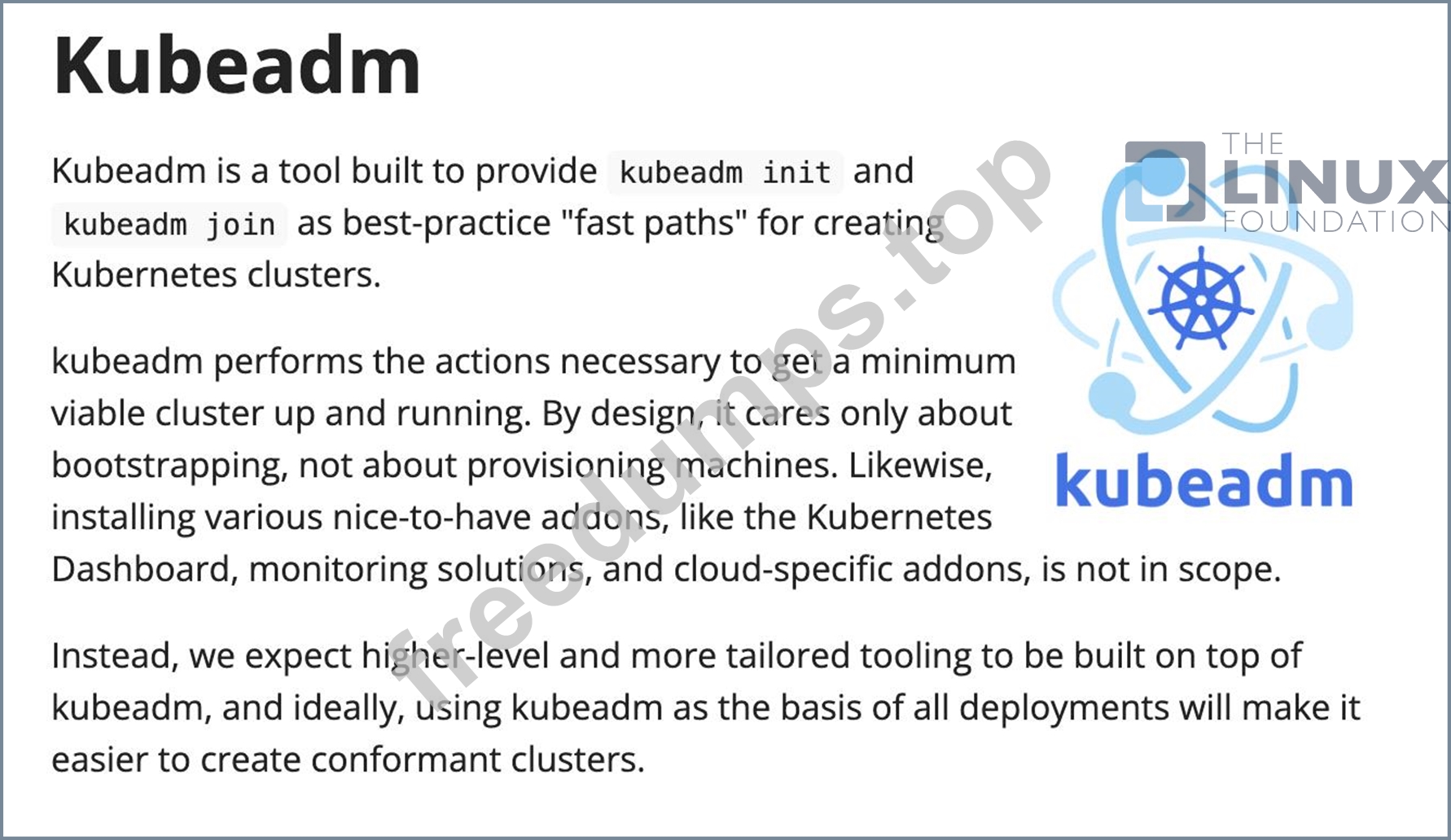
NEW QUESTION # 236
Which of the following best describes the way kubernetes Role-based access control (RBAC) works?
Answer: B
Explanation:
https://kubernetes.io/docs/reference/access-authn-authz/rbac/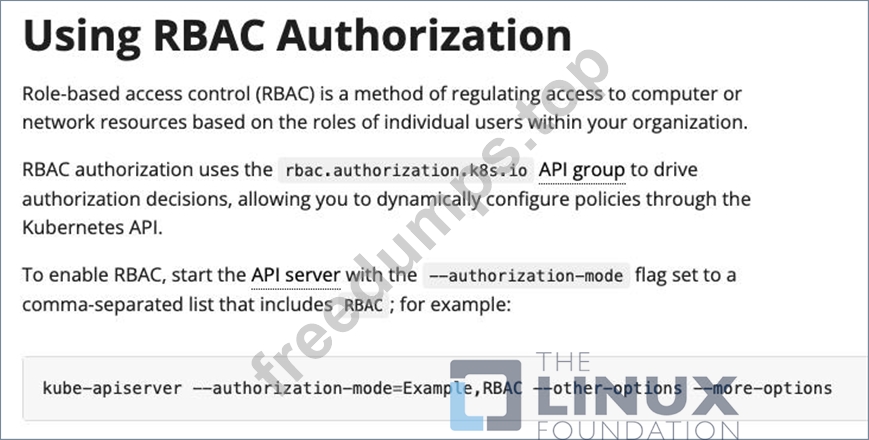
NEW QUESTION # 237
......
You may be complaining that your work abilities can't be recognized or you have not been promoted for a long time. But if you try to pass the KCNA exam you will have a high possibility to find a good job with a high income. That is why I suggest that you should purchase our KCNA questions torrent. Once you purchase and learn our KCNA Exam Materials, you will find it is just a piece of cake to pass the exam and get a better job. You can read the introduction of our KCNA exam questions carefully before your purchase. We provide the best service to you and hope you will be satisfied.
Study KCNA Reference: https://www.freedumps.top/KCNA-real-exam.html
2026 Latest FreeDumps KCNA PDF Dumps and KCNA Exam Engine Free Share: https://drive.google.com/open?id=1k_1BmLRantKJOkWTJpOvx0j7xs2ZVcbw