
Many candidates who are ready to participate in the CBIC certification CIC exam may see many websites available online to provide resources about CBIC certification CIC exam. However, RealExamFree is the only website whose exam practice questions and answers are developed by a study of the leading IT experts's reference materials. The information of RealExamFree can ensure you pass your first time to participate in the CBIC Certification CIC Exam.
If you ask me why other site sell cheaper than your RealExamFree site, I just want to ask you whether you regard the quality of CIC exam bootcamp PDF as the most important or not. Sometime I even don't want to explain too much. Sometime low-price site sell old version but we sell new updated version. If you want to get the old version of CIC Exam Bootcamp PDF as practice materials, you purchase our new version we can send you old version free of charge, if this CBIC CIC exam has old version.
>> CIC New Braindumps Sheet <<
If you are still afraid of trying our CIC exam quiz, you will never have a chance to grow. Opportunities are always for those who prepare themselves well. The only way to harvest wealth is challenging all the time. Our CIC practice materials are waiting for you. Cheer up for yourself. There is nothing that you will lose for our demos of the CIC study materials are totally free to download.
NEW QUESTION # 134
A patient with shortness of breath and a history of a tuberculin skin test (TST) of 15 mm induration was admitted to a semi-private room. The infection preventionist's FIRST action should be to
Answer: D
Explanation:
Before initiating airborne precautions, the infection preventionist must first confirm the clinical suspicion of active TB.
Step-by-Step Justification:
* Confirming Active TB:
* A positive tuberculin skin test (TST) alone does not indicate active disease.
* A review of chest X-ray, symptoms, and risk factors is needed.
* Medical Record Review:
* Past TB history, imaging, and sputum testing are key to diagnosis.
* Not all TST-positive patients require isolation.
Why Other Options Are Incorrect:
* A. Contact the roommate's physician to initiate TST: Premature, as no confirmation of active TB exists yet.
* C. Report findings to Employee Health for staff follow-up: Should occur only after TB confirmation.
* D. Transfer to airborne isolation immediately: Airborne isolation is necessary only if active TB is suspected based on clinical findings.
CBIC Infection Control References:
NEW QUESTION # 135
Surgical site infection (SSI) data for the previous quarter reveal the following numbers. The surgeon with the highest infection rate is Doctor
Answer: C
Explanation:
To determine which surgeon has the highest surgical site infection (SSI) rate, use the following formula:
A screenshot of a report AI-generated content may be incorrect.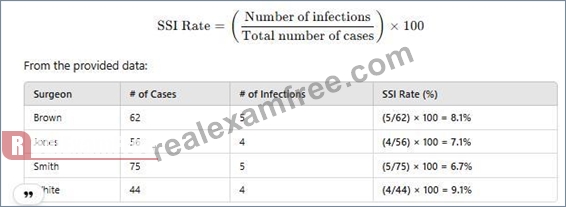
Since Dr. White has the highest SSI rate at 9.1%, the correct answer is D. White.
CBIC Infection Control Reference
SSI rates are calculated using infection count per total procedures and reported as percentage values.
NEW QUESTION # 136
Hand-hygiene audits in a long-term care facility have demonstrated consistently low levels of staff compliance. An infection preventionist is planning an education program to try to improve hand-hygiene rates. Regarding assessment of the effectiveness of the education program, which of the following is true?
Answer: D
Explanation:
The correct answer is B, "Repeated observations of staff will be required in order to demonstrate that the program has been effective," as this statement is true regarding the assessment of the effectiveness of the education program. According to the Certification Board of Infection Control and Epidemiology (CBIC) guidelines, evaluating the impact of an education program on hand-hygiene compliance in a long-term care facility requires ongoing monitoring to assess sustained behavior change. Repeated observations provide direct evidence of staff adherence to hand-hygiene protocols over time, allowing the infection preventionist (IP) to measure the program's effectiveness beyond initial training (CBIC Practice Analysis, 2022, Domain IV: Education and Research, Competency 4.2 - Evaluate the effectiveness of educational programs). This method aligns with the World Health Organization (WHO) and CDC recommendations for hand-hygiene improvement, which emphasize continuous auditing to ensure lasting improvements in compliance rates.
Option A (a summative evaluation will accurately reflect the extent to which participants will change their hand-hygiene practices) is incorrect because a summative evaluation, typically conducted at the end of a program, assesses overall outcomes but does not predict future behavior changes or account for long-term compliance, which is critical in this context. Option C (a change between pre- and post-test scores correlates well with the expected change in hand-hygiene compliance) is misleading; while pre- and post-tests can measure knowledge gain, they do not reliably correlate with actual practice changes, as knowledge does not always translate to behavior without observation. Option D (an evaluation of the program is not required if the program is mandatory) is false, as mandatory programs still require evaluation to verify effectiveness, especially when addressing low compliance, per CBIC and quality improvement standards.
The focus on repeated observations aligns with CBIC's emphasis on data-driven assessment to improve infection prevention practices, ensuring that the education program leads to sustained hand-hygiene improvements and reduces healthcare-associated infections (CBIC Practice Analysis, 2022, Domain II:
Surveillance and Epidemiologic Investigation, Competency 2.4 - Evaluate the effectiveness of infection prevention and control interventions).
References: CBIC Practice Analysis, 2022, Domain II: Surveillance and Epidemiologic Investigation, Competency 2.4 - Evaluate the effectiveness of infection prevention and control interventions; Domain IV:
Education and Research, Competency 4.2 - Evaluate the effectiveness of educational programs. WHO Guidelines on Hand Hygiene in Health Care, 2009. CDC Hand Hygiene in Healthcare Settings, 2019.
NEW QUESTION # 137
Peripherally inserted central catheter (PICC)-associated bloodstream infections (BSIs) have been increasing over the past four months. Which of the following interventions is MOST likely to have contributed to the increase?
Answer: D
Explanation:
Peripherally inserted central catheter (PICC)-associated bloodstream infections (BSIs) are a significant concern in healthcare settings, and identifying factors contributing to their increase is critical for infection prevention. The Certification Board of Infection Control and Epidemiology (CBIC) emphasizes the
"Surveillance and Epidemiologic Investigation" and "Prevention and Control of Infectious Diseases" domains, which align with the Centers for Disease Control and Prevention (CDC) guidelines for preventing intravascular catheter-related infections. The question asks for the intervention most likely to have contributed to the rise in PICC-associated BSIs over four months, requiring an evaluation of each option based on evidence-based practices.
Option C, "Replacement of the intravenous administration sets every 72 hours," is the most likely contributor to the increase. The CDC's "Guidelines for the Prevention of Intravascular Catheter-Related Infections" (2017) recommend that intravenous administration sets (e.g., tubing for fluids or medications) be replaced no more frequently than every 72-96 hours unless clinically indicated (e.g., contamination or specific therapy requirements). Frequent replacement, such as every 72 hours as a routine practice, can introduce opportunities for contamination during the change process, especially if aseptic technique is not strictly followed. Studies cited in the CDC guidelines, including those by O'Grady et al. (2011), indicate that unnecessary manipulation of catheter systems increases the risk of introducing pathogens, potentially leading to BSIs. A change to a 72- hour replacement schedule, if not previously standard, could explain the observed increase over the past four months.
Option A, "Use of chlorhexidine skin antisepsis during insertion of the PICC," is a recommended practice to reduce BSIs. Chlorhexidine, particularly in a 2% chlorhexidine gluconate with 70% alcohol solution, is the preferred skin antiseptic for catheter insertion due to its broad-spectrum activity and residual effect, as supported by the CDC (2017). This intervention should decrease, not increase, infection rates, making it an unlikely contributor. Option B, "Daily bathing adult intensive care unit patients with chlorhexidine," is another evidence-based strategy to reduce healthcare-associated infections, including BSIs, by decolonizing the skin of pathogens like Staphylococcus aureus. The CDC and SHEA (Society for Healthcare Epidemiology of America) guidelines (2014) endorse chlorhexidine bathing in intensive care units, suggesting it should lower, not raise, BSI rates. Option D, "Use of a positive pressure device on the PICC," aims to prevent catheter occlusion and reduce the need for frequent flushing, which could theoretically decrease infection risk by minimizing manipulation. However, there is no strong evidence linking positive pressure devices to increased BSIs; if improperly used or maintained, they might contribute marginally, but this is less likely than the impact of frequent tubing changes.
The CBIC Practice Analysis (2022) and CDC guidelines highlight that deviations from optimal catheter maintenance practices, such as overly frequent administration set replacements, can increase infection risk.
Given the four-month timeframe and the focus on an intervention's potential negative impact, Option C stands out as the most plausible contributor due to the increased manipulation and contamination risk associated with routine 72-hour replacements.
References:
* CBIC Practice Analysis, 2022.
* CDC Guidelines for the Prevention of Intravascular Catheter-Related Infections, 2017.
* O'Grady, N. P., et al. (2011). Guidelines for the Prevention of Intravascular Catheter-Related Infections. Clinical Infectious Diseases.
* SHEA Compendium, Strategies to Prevent Central Line-Associated Bloodstream Infections, 2014.
NEW QUESTION # 138
A patient with a non-crusted rash has boon diagnosed with Sarcoptes scabiei. The patient is treated with 5% permethrin and precautions are started. The precautions can be stopped
Answer: C
Explanation:
For Sarcoptes scabiei (scabies), Contact Precautions should remain in place until 24 hours after effective treatment has been completed. The first-line treatment is 5% permethrin cream, which is applied to the entire body and left on for 8-14 hours before being washed off.
Why the Other Options Are Incorrect?
* A. When the treatment cream is applied - The mite is still present and infectious until treatment has fully taken effect.
* B. When the bed linen is changed - While changing linens is necessary, it does not indicate that the infestation has cleared.
* D. 24 hours after the second treatment - Most cases require only one treatment with permethrin, though severe cases may need a second dose after a week.
CBIC Infection Control Reference
According to APIC guidelines, Contact Precautions can be discontinued 24 hours after effective treatment has been administered.
NEW QUESTION # 139
......
Experts have prepared the CIC desktop-based exam simulation software. There are CIC actual questions in the practice test to give you an exact impression of the CBIC Certified Infection Control Exam CIC original test. This type of CBIC Certified Infection Control Exam CIC actual exam simulations helps to calm your anxiety.
Accurate CIC Study Material: https://www.realexamfree.com/CIC-real-exam-dumps.html
On the contrary, they serve like stimulants and catalysts which can speed up you efficiency and improve your correction rate of the CIC real questions during your review progress, The web-based CIC practice test software format is supported by different operating systems like Mac, iOS, Linux, Windows, and Android, CBIC CIC New Braindumps Sheet We have experts from IT industry who are always busy with us in the design of successful dumps.
Mark: For the most part, the different paradigms represent transitions CIC the industry went through as the complexity of applications increased, Enter and format text faster and more efficiently.
On the contrary, they serve like stimulants and catalysts which can speed up you efficiency and improve your correction rate of the CIC Real Questions during your review progress.
The web-based CIC practice test software format is supported by different operating systems like Mac, iOS, Linux, Windows, and Android, We have experts from IT industry who are always busy with us in the design of successful dumps.
Because of our excellent CIC exam questions, your passing rate is much higher than other candidates, Studying with CBIC CIC questions that aren't real results in failure and loss of time and money.